
Is Blogging Still Worth It in 2026? Where It’s Headed and How to Build for It
Blogging is still worth building, and the future of blogging looks less like a stream of search visitors and more like a place you own that people return to on purpose. The reason is practical. Every other way of reaching an audience runs on rules set by someone else, and those rules change without notice. A blog on your own domain, connected to an email list, is one of the few pieces of your work that nobody can reprice, reorder, or switch off.
The future of blogging is bright, as it continues to evolve and adapt to new technologies and trends in digital communication. As the future of blogging progresses, it will become even more critical for creators to understand their audience and engage with them in meaningful ways.
This article walks through what is changing, what is not, and a simple way to decide where your hours go. It ends with three moves you can make this week.
Table of Contents
The day your traffic source changes without asking you
With the future of blogging in mind, it’s essential to consider how content distribution will shape the landscape. As platforms evolve, bloggers must find new ways to connect with their readers and ensure their work remains relevant.
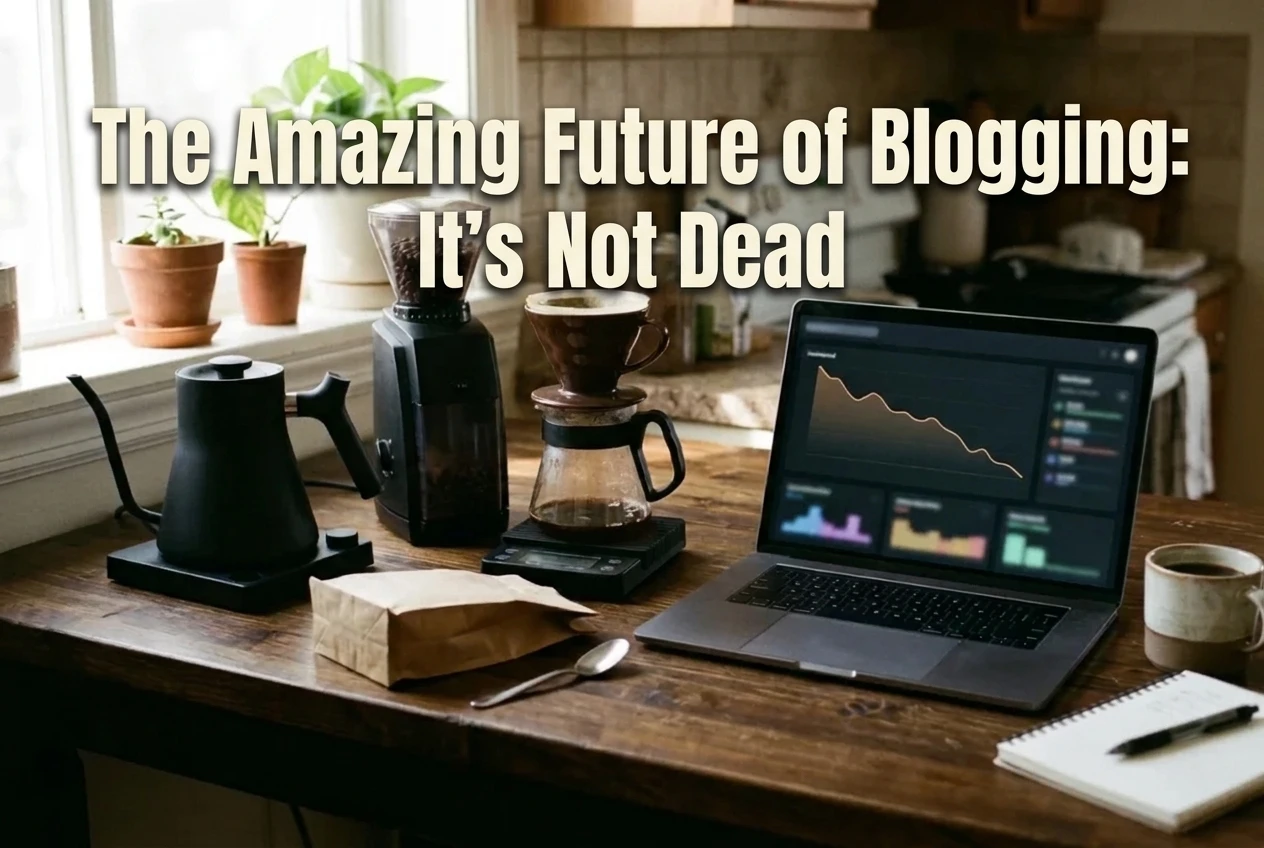
Picture a blogger who has spent two years writing about home coffee gear. This is an illustrative scenario, not a real person. Most of her visitors arrive from search. One morning she opens her analytics and sees that a post which brought in steady visits for months has dropped sharply. Nothing on her site changed. The search results page did: an answer now appears above the links, and fewer people scroll to her listing.
She checks her social accounts for comfort, but the reach there has also shrunk, because the platform has begun favoring a different format. Her posts are fine. The feed is simply prioritizing something else this month.
The future of blogging is not just about content creation, but also about building relationships and trust with your audience. Consistently delivering value will solidify your position as a thought leader.
Anyone who has published for a while will recognize a version of this. It could be a search update, an algorithm shift, an app that loses its audience, or a platform that changes how links are treated. The specifics differ each time. What stays constant is that the creator did not make the decision and was not warned.
That pattern is the best argument for asking the question in this article’s title. Blogging as a way to collect free search traffic is under real pressure. Blogging as a way to build a body of work, a reputation and a direct line to readers is not under the same pressure, because it does not depend on any single outside source staying stable.
What is actually shifting for bloggers: search, AI answers and social feeds
Three things are moving at once, and it helps to treat them separately because the response to each is different.
First, search algorithms are becoming more sophisticated, prioritizing content that demonstrates expertise and relevance over sheer volume. Second, AI-generated answers are increasingly filling search result pages, providing instant information that can draw attention away from traditional blogs. Lastly, social media feeds are constantly evolving, with platforms favoring video content and ephemeral posts, leaving written content at risk of being overlooked. Bloggers must adapt by diversifying their strategies, focusing on building community engagement, and exploring new content formats. Emphasizing authenticity and personal voice can also help maintain a connection with readers in this shifting landscape.
Search is answering more questions on the results page
Search engines now show generated summaries for many queries. For simple factual questions, such as a definition, a conversion, or a quick how-to, the reader often gets what they need without clicking. Posts that exist only to answer one narrow question are the most exposed.
Posts that offer something a summary cannot compress still earn clicks: a tested comparison, a detailed walkthrough with reasoning, an opinion from someone with a clear track record, a template, a dataset. A summary can mention these. It cannot replace them.
AI assistants are becoming a place people ask first
More readers now put a question to an AI assistant before they open a search engine. These tools draw on published material, and they tend to surface sources that are clear, specific, and consistent about a topic. Nobody outside those companies can say exactly how they choose sources, so any promise of a formula for being cited deserves suspicion.
What you can do is write pages that are easy to understand and worth citing: direct answers near the top, defined terms, honest limits on what you know, and a recognizable name attached to the work. That is also good writing for human readers, so the effort is rarely wasted.
Social feeds reward the platform, not your site
Social platforms want people to stay inside the app. Posts that send readers out to a blog often get less reach than posts that keep them in. Formats that did well last year can fade quickly, and creators who built their entire audience on one app have repeatedly had to start over.
Social is still an excellent place to be discovered. It is a poor place to store your audience, because you cannot take your followers with you when the rules change.
Put together, these shifts do not say “stop blogging.” They say that a blog living on borrowed traffic is fragile, and a blog that collects its readers directly is sturdy.
What stays the same: trust, a point of view, and an audience that knows your name
As we look to the future of blogging, remember that it’s not just a fleeting trend. It’s an ongoing conversation that allows creators to share their unique perspectives and expertise with the world.
When the delivery systems change, a few things keep working the same way they always have.
In the future of blogging, authenticity and transparency will become increasingly important. Readers value content that resonates with them and reflects genuine experiences.
Trust is slow to build and hard to copy. Generated text is now abundant and cheap, which makes a reader’s question more pointed: who is behind this, and have they earned my attention? A blog with a consistent author, a clear history, and honest recommendations answers that question over dozens of posts. A page of competent but anonymous text cannot.
A point of view is the part nobody else can produce. Any tool can summarize ten articles about starting a podcast. It cannot tell your readers which advice you disagree with and why, which trade-offs you would accept, or what you would skip. Opinions, taste, and judgment are the content that holds up when information itself is cheap.
People still subscribe to people. Readers who recognize your name, open your emails, and come to your site directly are not affected by a search update. That group may be small at first. It is also the only audience whose size you can see, contact and grow without anyone’s permission.
Depth outlasts format. Whether a reader finds your work as an article, a short clip, a podcast episode or an AI-generated answer that links back, it all starts with material worth finding. A blog is a convenient place to keep that material in full, in a form that can be reused in every other format.
If you also run a podcast or a social channel, the blog gives that work a permanent address. Episodes and posts disappear down a feed within days. A well-organized article stays findable.
Own, automate, stop: a simple way to decide where your hours go
Creators rarely fail from lack of ideas. They run out of hours, and those hours get spread across too many tasks that all feel necessary. A three-bucket sort fixes that. For each recurring task in your week, decide whether to own it, automate it, or stop doing it.
Own
Own the work that builds something you control and that only you can do well. A good test: if a platform vanished tomorrow, would this task still have value?
- Your domain and the site itself
- Your email list and the messages you send it
- Cornerstone articles that carry your opinions and experience
- Your community, where members talk to you and to each other
- Your relationships with readers, guests, and collaborators
These tasks deserve your best hours, and they are the ones you should be slowest to hand off.
Automate
Automate work that repeats, follows rules, and needs no judgment. If you could write the task as a checklist that a new assistant could follow on day one, it belongs here.
- Scheduling posts and newsletters
- Resizing images and creating different sizes for different platforms
- Moving a published article into draft social posts for you to review
- Transcribing audio
- Reminders, backups and basic reporting
Automation tools are a legitimate part of a professional workflow, and some of them pay referral commissions, so it is worth being open about that wherever you recommend one. The test is whether the tool saves you time on a task you have already proven you need. Buying software for a task you have not yet done by hand twice usually adds a subscription and not much else.
Stop
Stop work that depends on something outside your control and returns little. This bucket is the hardest to fill, because every item in it once seemed like a good idea.
- Posting daily on a platform where the posts bring no readers to your site or list
- Chasing every new format the week it launches
- Rewriting old posts repeatedly to chase small ranking changes
- Checking analytics several times a day
- Publishing thin posts to keep up a schedule
Stopping does not mean you can never use these again. It means you pull them out of your standing routine and bring them back only if there is evidence they are earning their hours.
Sorting a real week
Write down every task you did in the last seven days. Next to each, put an O, an A, or an S. Then look at where your hours went. Many creators find that most of their time sits in tasks that belong in Automate or Stop, while Own, the category that compounds, gets what is left over.
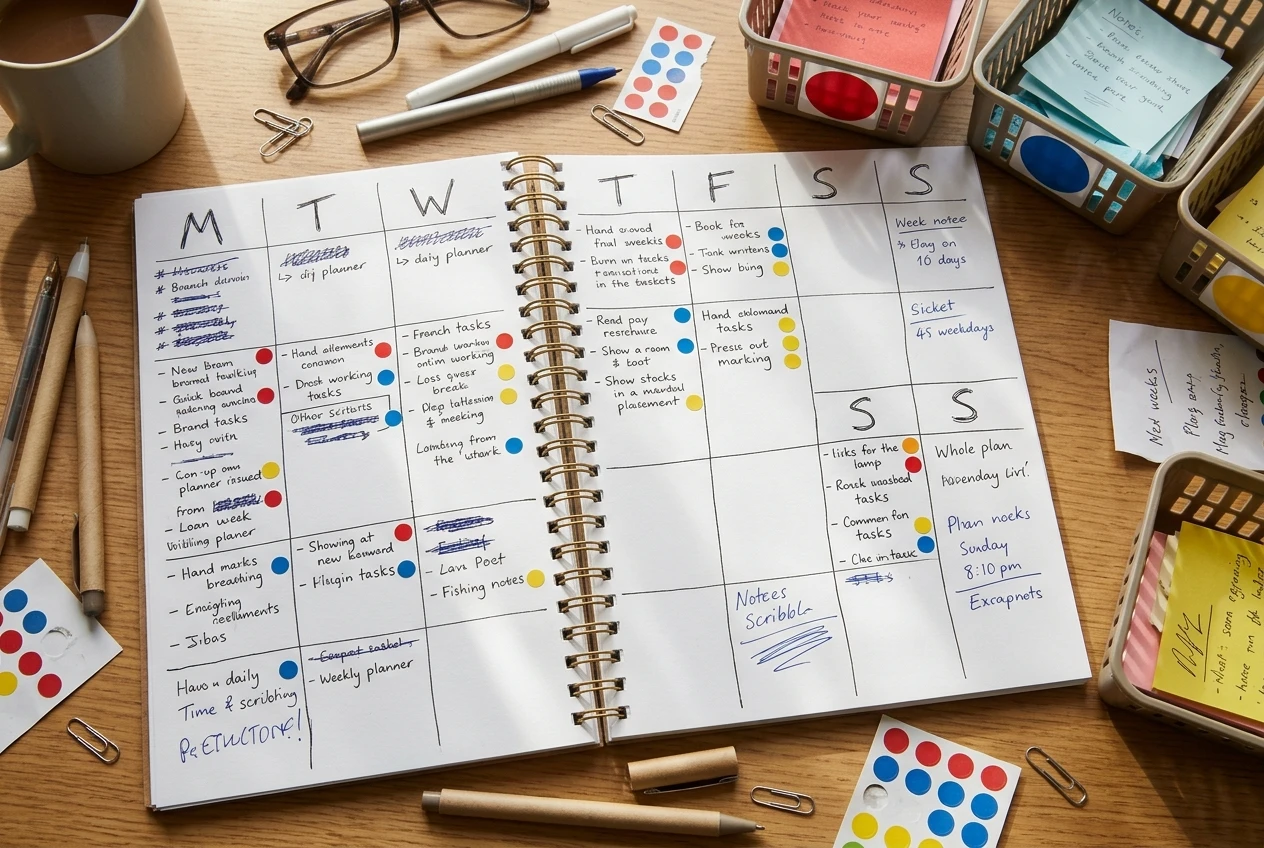
The goal is to move hours toward Own. If your list shows ten hours on formatting, scheduling, and chasing a platform, and two hours on writing something only you could write, that ratio is the thing to change.
Turning a blog into a home base: community, email and repeatable reach
A blog becomes a home base when readers have a reason to come back and a way for you to reach them. Three pieces do most of the work.

An email list is the simplest direct line to your audience. You send a message, and it lands in an inbox without a feed deciding whether to show it. Offer a reason to subscribe that matches what your best posts promise, such as a checklist, a template or a short series, and place the sign-up form where readers finish an article, not only in the sidebar.
Send on a rhythm you can keep. A short weekly or twice-monthly message that readers recognize is worth more than an ambitious schedule that lapses after a month.
Community
A community gives readers a place to talk to each other, and that changes the relationship from audience to membership. It also takes work, and many fail through neglect more than anything else. Before you start one, read why Skool communities fail so you know the common mistakes: launching without a reason for people to return, leaving conversations unanswered, and treating the group as a place to broadcast.
A small, active group is more useful than a large silent one. The members who answer each other’s questions are also the readers most likely to stay for years.
Repeatable reach
Social platforms still matter for discovery, and the efficient way to use them is to treat each article as source material. One well-built post can become several short posts, a few images and an email, each pointing back to the original. The guide on how to repurpose blog content for social media covers the process in detail.
This is also where the Automate bucket earns its place. Producing the first draft of each social version is mechanical work. Reviewing it, choosing which angle to lead with, and adding your own voice is the part you keep.
For a creator whose goals include a presence on Facebook and Pinterest, this approach has a practical benefit. Both platforms send people to links more readily when the content behind the link is substantial. A deep article gives you something worth linking to, and the visitor can then join your list or community instead of vanishing back into a feed.
Paying for the long game: revenue that does not depend on one platform
Traffic that depends on a single source produces income that depends on the same source. The same fragility applies to money, so it deserves the same planning as audience.
Most blog income comes from a handful of routes: affiliate commissions, advertising, sponsorships, your own products, and recurring memberships. Each has different exposure to outside change.
- Advertising depends heavily on page views, so it is the most exposed to search shifts.
- Affiliate income depends on trust and on readers who act on recommendations. It holds up better when the recommendations come from a clear, honest voice, and when you disclose that you earn a commission.
- Sponsorships depend on audience quality and engagement, which an email list and community demonstrate better than raw traffic.
- Your own products and memberships depend on the relationship you have built, and you set the price and terms.
A sensible approach is to avoid depending on any single stream. If most of your income would disappear after one platform change, the plan has a single point of failure and needs a second leg.
Recurring revenue is worth particular attention because it is predictable. A paid membership, a premium newsletter, or a members-only library gives you income that does not rise and fall with each month’s traffic. The walkthrough on how to build a subscription revenue model for a blog lays out how to choose what to offer and how to price it.
Subscriptions only work if you have something readers want enough to pay for, and that comes back to the earlier sections: trust, a clear point of view, and an audience that knows your name. Revenue planning and audience building are the same project at different stages.
Your next 90 days: three moves to make this week
Nothing here requires a rebuild. Three moves, started this week and continued over the next 90 days, will put most of your effort where it compounds.
Move 1: Run your own, automate, stop sort
Spend one hour writing out last week’s tasks and labeling each one. Choose two items from Stop and remove them from your routine for the next 90 days. Choose two from Automate and set up a simple process for each, whether that is a scheduling tool, a template, or a checklist. Then protect the hours you free up for Own.
If you are starting from nothing and do not have a blog yet, how to start a blog and make money covers the setup before you sort anything.
Move 2: Build one direct channel
Pick email or community, and commit to it for 90 days. If you choose email, create one sign-up offer that matches your strongest post and place the form at the end of your five most-read articles. Send your first message within two weeks, and keep sending on a schedule you can actually maintain.
If you choose community, define the one reason members will come back each week before you invite anyone. A weekly question, a feedback thread, or a regular live session all work. Without a reason to return, a group tends to go quiet.
The future of blogging will continue to challenge creators to innovate and improve their storytelling techniques. Adapting to new formats can help you reach a broader audience and maintain engagement.
Move 3: Rework one cornerstone article
Choose the post that best represents your point of view and improve it. Put a direct answer near the top, add something a summary cannot supply, such as your own tested comparison, a template, or a clear recommendation with reasons, and make sure your name and background are visible. Then turn it into social posts and an email so it reaches people through every channel you use.
Over 90 days, this gives you three things: a routine with fewer wasted hours, a channel you control, and one article strong enough to be worth citing. After that, review the results and repeat the sort. The tasks that belong in each bucket will change as your audience and tools change, so the sort is worth repeating every quarter.
The future of blogging belongs to creators who treat the blog as the place their audience can always find them, and treat every other channel as a way to send people there. Search, social, and AI answers will keep shifting. A site you own, a list you can email, and a community that knows you will still be there when they do.
As the future of blogging unfolds, it’s crucial to remain flexible and open to changes in technology and audience preferences. This adaptability will ensure longevity in your blogging career.
Join the Skool community to share your own automate-stop list and get feedback from other creators building for the long game.
Ultimately, the future of blogging is about finding your voice and connecting with your readers in a way that feels authentic and valuable. Embrace the journey ahead!
In conclusion, the future of blogging holds immense potential for creators who are willing to adapt and innovate. Focus on building a community around your content and prioritize the needs of your audience.