
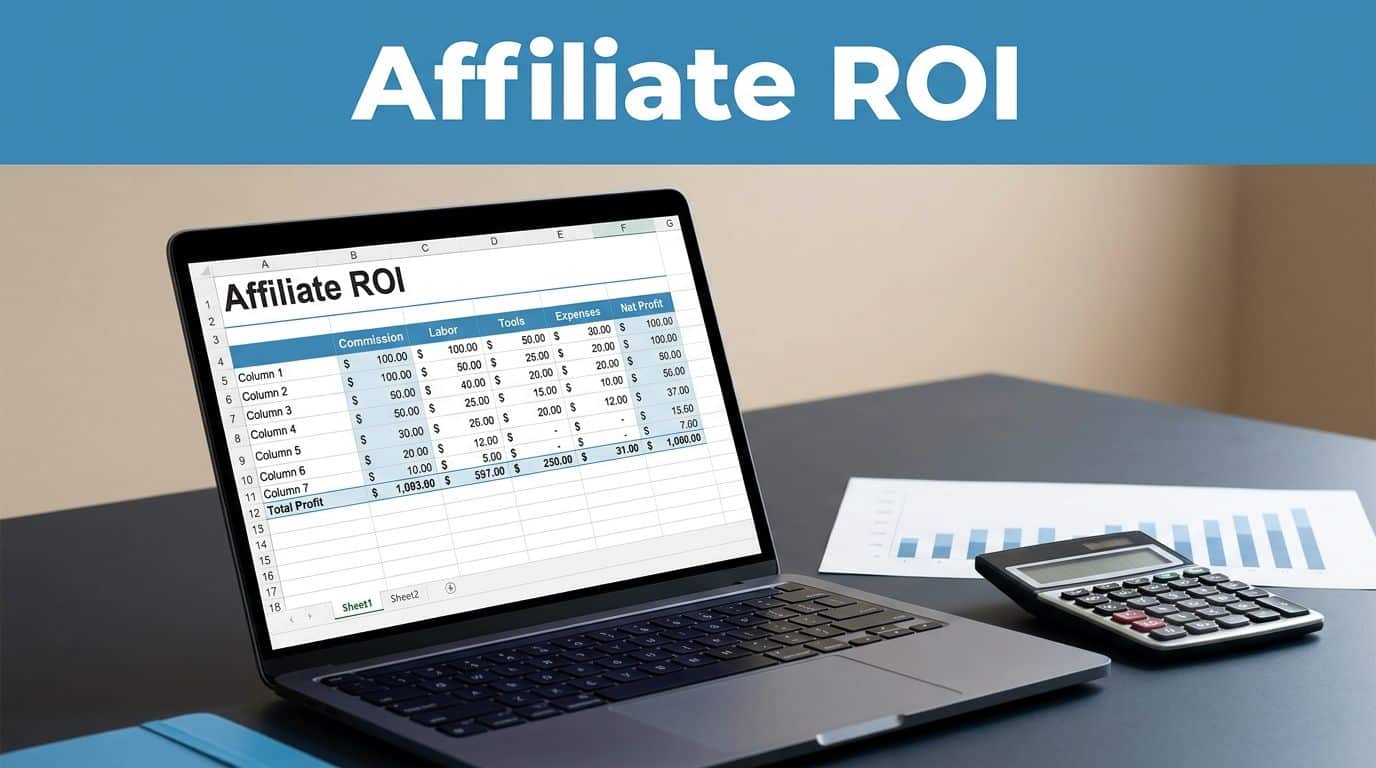
An affiliate dashboard can look like a winner, but an affiliate marketing ROI calculation may tell another story once it includes labor, tools, and your time. A $1,000 commission total is not a $1,000 gain once you count writing, editing, and the hours behind the post.
Understanding your affiliate blog ROI can help in strategic planning.
Calculating your affiliate blog ROI requires attention to detail.
Focus on enhancing your affiliate blog ROI through quality content.
An honest affiliate blog ROI spreadsheet puts the money earned beside the money spent. That makes your next move clearer: update a review, switch offers, or stop feeding a post that only eats your time.
Before you spend hours refining a sheet, build posts that answer real buyer questions. Learn to Blog Like A Beast is a practical place to get your blogging system, content plan, and monetization ideas in order.
This post may contain affiliate links. If you make a purchase through these links, I may earn a small commission at no extra cost to you.
Table of Contents
Key Takeaways
- Calculate affiliate blog ROI from approved net commissions, not the customer’s total order value, and remove refunds, reversals, and rejected transactions.
- Include labor, tools, promotion, platform fees, and other attributable expenses, so your spreadsheet shows net profit rather than revenue.
- Use a simple monthly spreadsheet with consistent attribution rules, tracking IDs, formulas, and notes for unusual activity or fraud detection flags.
- Review conversion rate, earnings per click, average order value, refund rate, and customer lifetime value together to understand why an asset performed well or poorly.
- Let net profit and ROI guide your next action: update the content, improve distribution, test the offer, or stop spending time on it.
How to Calculate Affiliate Blog ROI That Shows Real Profit
Affiliate programs are paid-for-results arrangements. A merchant pays a commission when a tracked referral converts, which is the basic model explained in this affiliate program overview. Affiliate marketing ROI measures what remains after creating and promoting that referral, while affiliate program ROI isolates one offer’s economics.

Tracking affiliate blog ROI is essential for growth.
Use your commission, not the customer’s cart total
Many affiliate dashboards spotlight attributed sales or average order value. Those figures describe shopper spend, not your income.
Analyzing affiliate blog ROI helps identify successful strategies.
The impact of the content on affiliate blog ROI cannot be overstated.
A $200 software purchase under a 30% commission structure earns you $60. Recurring terms or tier-based rates can change the amount. If the buyer asks for a refund, that commission may disappear later.
With recurring subscriptions, customer lifetime value provides useful context. A longer relationship may affect your evaluation, but don’t count future revenue you won’t receive.
Use different methods to analyze your affiliate blog ROI.
Start with approved commissions, including sales credited through links or discount codes. Then remove refunds, reversals, chargebacks, and transactions held or rejected by fraud detection.
Reports from affiliate networks may use different approval, refund, or payment rules. Document the attribution models used before comparing results.
Don’t forget to factor in all expenses when calculating affiliate blog ROI.
Your two core calculations are simple:
- Net profit from the referral = net commission minus total attributable costs.
- Return on investment = that result divided by total attributable costs, multiplied by 100.
Your affiliate blog ROI should reflect true profits.
Improve your strategies based on affiliate blog ROI insights.
If you earned $680 after spending $400, the result is 170%. You made $1.70 in profit for every dollar invested.
Conversion rate is a useful diagnostic, but it doesn’t show whether the referral was profitable. Track it separately from profitability.
Give your own time a real price
The costs people forget are usually sitting in their calendar. Include freelance writers, editors, stock photos, paid traffic, email software, keyword tools, link-management tools, and your own labor when calculating cost per acquisition.
Separate program costs, such as processing or platform fees, from creator labor and tools.
I price my time at the rate I would pay a capable person to do the same job. You can use your current hourly rate, or a fair contractor rate. The number matters less than using it consistently.
If you would pay someone else to do the job, it belongs somewhere in the cost column.
Shared subscriptions need a sensible allocation. Divide a monthly tool cost across the content assets or work hours that used it. Don’t charge one product review for an entire year of software.
Build a Simple Spreadsheet You Will Actually Update
I like a one-tab monthly report because it removes the excuse to overbuild and makes affiliate marketing ROI easier to see. Use one row for each post, video, email campaign, or referral source you want to judge.

One row can show whether a content asset earns its keep.
Start with the columns that tell the whole story
Your spreadsheet doesn’t need 40 columns. It needs enough information to connect an affiliate payout to the work that produced it.
| Month | Page or Channel | Unique Clicks | Gross Commissions | Refunds | Labor Cost | Other Costs | Net Commission | Net Profit | ROI |
|---|---|---|---|---|---|---|---|---|---|
| July | Product roundup | 240 | $1,200 | $120 | $180 | $220 | $1,080 | $680 | 170% |
In this example, $220 could include an editor, a share of your email platform, image costs, and a small promotion budget. Total cost is $400. Net profit is $680. When click data is available, earnings per click add useful context without turning the sheet into a 40-column dashboard.
Without those costs, the post appears to have produced $1,200. That is revenue talk. Your spreadsheet is there to show profit.
Add formulas and a notes column
Create a formula for net commission: =Gross Commissions-Refunds. Then calculate total cost by adding labor and other costs. Your profit formula is net commission minus total cost.
For ROI, use =(Net Commission-Labor Cost-Other Costs)/(Labor Cost+Other Costs), then format that cell as a percentage. If total cost is zero, leave the ROI cell blank. A divide-by-zero error doesn’t tell you anything useful.
Keep a notes column too. Record link IDs or export data from affiliate tracking software, plus the attribution models used for the report. Note an odd country mix, mismatched landing pages, or email subscribers who opened the lead magnet but ignored the offer. Add a fraud detection flag when suspicious clicks, refunds, or approval changes affect a row. For recurring offers, record customer lifetime value only when the underlying program provides meaningful retention or repeat-purchase data.
Track the Right Numbers Before You Judge a Post
A spreadsheet only works when every number follows the same reporting rule. For affiliate program ROI, I use the month of the click or sale to judge content performance. I keep a separate cash-received view for commissions paid later, rather than mixing payment timing with attribution models.
Don’t let last-click attribution rewrite history
Last-click attribution gives all the credit to the final link a buyer used. It’s only one of several attribution models. First-click credits the opening touchpoint, while position-based models split credit across key interactions.
For direct affiliate reporting, count the commission credited to your link. Add an “assisted” note when a blog post, YouTube video, email, or podcast episode clearly started the buyer’s journey. Attribution models such as multi-touch attribution can capture that influence, but direct commission reporting and assisted notes serve different purposes.
Use separate tracking IDs or sub-IDs for each traffic source. Give product reviews, resource pages, newsletters, landing pages, and discount codes distinct identifiers instead of one anonymous link. Add a basic fraud detection check for suspicious source activity or abnormal click patterns. This affiliate link tracking guide gives a useful look at tracking links and campaign-level reporting.
Measure the metrics that explain the result
Clicks show interest, but they don’t show earnings. Watch these numbers together to understand affiliate performance. Read them alongside the offer’s commission structure, since recurring commissions, one-time payouts, or different rates can change the comparison. Review fraud detection flags before treating a spike as genuine performance.
- Conversion rate is approved orders divided by affiliate clicks.
- Earnings per click is approved net commission divided by clicks.
- Average order value is approved sales revenue divided by approved orders. It can explain why one product pays more per sale.
- Refund rate is refunded orders divided by approved orders, showing whether the offer matches what readers expected.
If you collect email leads before recommending a product, add leads and email revenue too. Customer lifetime value adds context when repeat purchases or subscription retention generate future revenue. Just don’t count the same commission twice in your post row and email row.
Use the Spreadsheet to Improve Content, Not Chase Vanity Sales
A good spreadsheet is a decision tool, not a trophy case. Review it monthly. Assign one clear next action to each asset using affiliate performance and affiliate marketing ROI.
Read patterns, not one lucky month
The lessons learned from affiliate blog ROI are invaluable.
High clicks with no commissions may signal poor-fit visitors, suspicious activity, or a mismatch between the offer and audience. Check the conversion rate by traffic sources. Use fraud detection to investigate click spikes before blaming the product or price.
That is why buyer intent keyword research matters in your affiliate marketing strategy before you publish. High traffic volume can’t rescue a post if readers only want a definition, not a purchase.
Low clicks with strong earnings per click tell a different story. Improve internal links, refresh the title, or review whether your landing pages support the offer. Mention the article in your email list if it already has the right offer and needs more qualified visitors.
Compare average order value and customer lifetime value before changing offers. A high-value recurring offer may deserve more attention than a one-time, low-value offer, even if it earns fewer initial commissions.
Compare channels on the same terms
Regularly revisit your affiliate blog ROI process.
Blogs aren’t the only assets worth tracking. YouTubers can create a row for each video, while podcasters can track an episode or a full podcasting campaign. Apply consistent attribution models across blogs, videos, email, podcasts, and communities, because multi-touch attribution can credit assisted conversions differently.
Skool community owners should label lesson links, welcome emails, and resource posts separately. Skool groups can send repeat visitors for months, which means an old recommendation may earn long after publication.
Compare affiliate program ROI across merchants and offers. Don’t compare it with Google or Meta ad revenue unless the math matches. Paid media ROI often uses revenue divided by ad cost, while cost per acquisition focuses on acquisition spend. Affiliate analysis includes labor and tools, so compare return on investment only after applying the same attribution models across channels.
Use the sheet to guide your content creation and content marketing. Results from top-performing affiliates are useful benchmarks only when audience, offer, attribution rules, and cost assumptions match. A positive percentage is helpful, but net profit matters more: a 400% return on $10 produces only $40.
Keep Tools in Their Proper Place
Enhancing your affiliate blog ROI should be a priority.
Understanding affiliate blog ROI is key to success.
Track variations in your affiliate blog ROI to identify trends.
Start with your affiliate dashboard, analytics, payment records, and a spreadsheet; that’s enough for most newer creators. Growing sites may need to reconcile reports from affiliate networks, traffic sources, and conversion rate records in the same sheet. Affiliate tracking software can organize links and reports, but it can’t replace approved payment records or a complete cost column. Dashboard data may contain invalid activity or delayed approvals, so use fraud detection checks before treating every number as final. Verify the platform’s fraud detection reporting before trusting automated totals.
As your site grows, clean link organization saves real time. Label recommendations, discount codes, and source details consistently so reconciliation stays simple. WordPress users with recommendations spread across many posts may benefit from affiliate link management plugins.
A good strategy enhances your affiliate blog ROI.
You can also use 90+ AI-Powered Tools for Bloggers to plan update briefs and repurpose winning topics. Tools should support a defined affiliate marketing strategy, not become the process.
Reviewing your affiliate blog ROI regularly is essential.
Add software only when it answers a real question and offers documented attribution models that match your spreadsheet’s rules. Keep program costs reported by a merchant or affiliate program separate from software subscriptions and other creator expenses. Recurring revenue may justify deeper tools when customer lifetime value data is genuinely available.
Your goal should always be to improve affiliate blog ROI.
Keep refining your metrics for a better affiliate blog ROI.
Transparent calculations improve your affiliate blog ROI.
For merchants: Affiliate recruitment is a separate workflow from tracking creator-owned recommendations.
The right focus on affiliate blog ROI can change everything.
Keep your disclosures obvious near recommendations. The FTC explains its expectations for clear material-connection disclosures in its Endorsement Guides FAQ. Trust matters more than squeezing one more click from a reader.
A strong understanding of affiliate blog ROI will lead to better decisions.
For feedback on your tracker and your next content decision, theBlogMan Academy on Skool is a free-to-join academy of content creation for creators building practical online income.
Frequently Asked Questions
What is affiliate blog ROI?
Affiliate blog ROI measures the profit a blog asset produces after affiliate commissions are adjusted for refunds and all attributable costs. Those costs can include labor, software, promotion, and other expenses connected to creating and promoting the content.
How do you calculate affiliate marketing ROI?
First, calculate net commission by subtracting refunds and reversals from approved commissions. Then subtract labor and other costs to find net profit, and divide net profit by total attributable costs before multiplying by 100.
Should I include my own time in the ROI calculation?
Yes, your labor is a real cost even when you do the work yourself. Price your time using a consistent hourly rate, such as what you would pay a capable contractor to complete the same task.
Which metrics should I track besides ROI?
Track conversion rate, earnings per click, average order value, refund rate, and customer lifetime value when reliable data is available. These metrics help explain whether a result came from qualified traffic, a strong offer, repeat purchases, or an unusually high refund rate.
Prioritize actions based on your affiliate blog ROI.
How often should I review my affiliate ROI spreadsheet?
Focus on increasing your affiliate blog ROI over time.
A monthly review is usually frequent enough to identify useful patterns without reacting to one lucky sale or an isolated weak period. Assign one next action to each content asset, such as updating it, improving traffic, testing a new offer, or stopping further work.
Your Numbers Should Tell You Where to Spend Tomorrow
Your approach to affiliate blog ROI must be strategic.
Your spreadsheet doesn’t need a fancy dashboard. It needs approved commissions, honest costs, and notes that explain why results changed. Keep attribution models consistent from month to month.
Leverage your findings on affiliate blog ROI for better returns.
Affiliate marketing ROI isn’t an income promise. It’s a practical return on investment measure for deciding where your next hour has a better chance of paying you back.
Use the result to guide your affiliate marketing strategy. Decide what to publish, update, test, or stop tomorrow.
If you’d like a second pair of eyes on your tracker, Join Me for a chat at theBlogMan Academy of Content Creation.


