
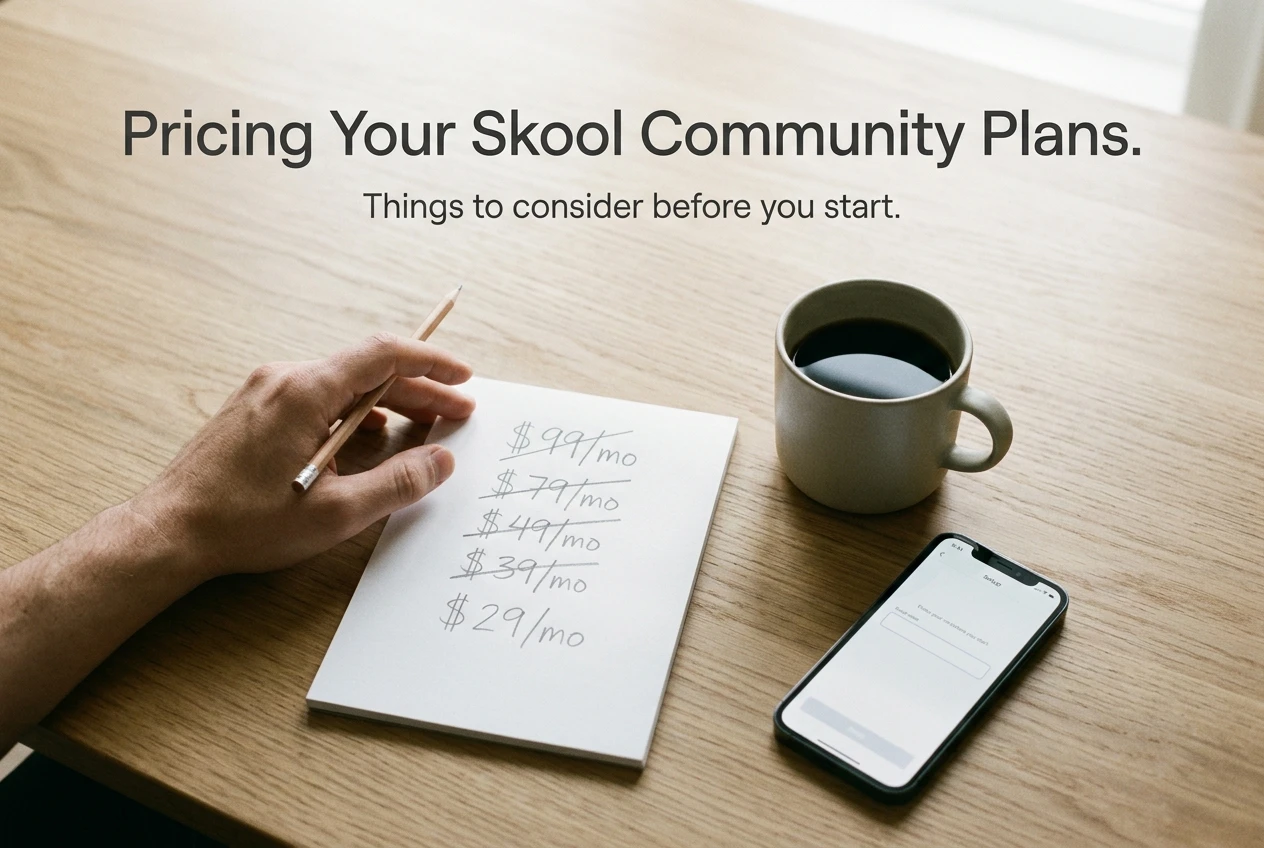
How to Price Your Skool Community So Members Feel the Premium Is Worth It
You open the pricing field, type a number, delete it, and type a different one. This can go on for days. The stall usually has little to do with arithmetic. The number you choose says what you think members will get, and if you cannot yet name that clearly, every figure feels wrong.
This piece is about how to price a Skool community so that each tier is backed by something members receive every week. It assumes you already have an audience and an idea. If you are still unsure the idea has demand, work through how to validate a Skool community idea first and come back.
Why you stall on the price (and what the number is really saying)
A price tells a prospective member three things before they read your description: how much attention they will get, how big the result is, and how serious the community is. A low price suggests a library of files. A high price suggests a person who answers back.
That is why creators freeze. Picking $15 or $50 means committing to a story about delivery. If you have not decided whether you will review members’ work, run live sessions, or just host a discussion feed, you cannot price it, and no competitor’s page will settle it for you.
So decide what you will deliver each week, then attach the number. The rest of this article follows that order.
The three questions that set your price before you look at competitors
Looking at other communities first anchors you to their pricing, which reflects their delivery and not yours. Answer these three questions on paper first.

- What result does a member get, and how soon can they see it? “Publish your first three episodes” is a result. “Grow as a creator” is not. The sharper the result, the easier it is to defend a higher price.
- What does delivery cost you each week in hours? Count live calls, written feedback, moderation, and preparation. If one member gets 20 minutes of your feedback each week, 50 members need more than 16 hours of your time before anything else.
- What would a member pay to get the same result without you? Think of the courses, tools, freelancers, or months of trial and error they would otherwise use. Your price should sit comfortably below that total while covering your hours.
The second question sets your floor and the third sets your ceiling. The price belongs somewhere between them, and the gap tells you how much room you have.
What members must get in return for a premium: access, feedback and a visible result
A premium tier is justified when it delivers something a free or low tier cannot. In a community, that comes down to three things.
- Access: direct contact with you. This can be a weekly live session, a question thread you answer personally, or a monthly call. Access is scarce because your hours are scarce, which is why it commands a premium.
- Feedback: someone looks at the member’s actual work and responds. A review of a draft, a thumbnail, an episode outline, or a channel page is worth more than general advice because it applies to their situation.
- A visible result: something the member can point to after a set period. A published post, a finished lead magnet, a posting schedule they have kept for four weeks.
Notice that all three can be scheduled. “Every Tuesday I review submitted work” is a promise a member can check. “Lots of value” is not. If a tier cannot be described as a weekly event, it is not ready to be priced.
A walk-through: pricing one creator’s community from free tier to premium
The following is an illustrative example, not a real case. The creator and the numbers are made up to show the reasoning, so replace them with your own.
Picture Maya, a podcaster who wants to help other new podcasters publish consistently. She starts by answering the three questions.
Her result: a member publishes three episodes within their first month. Her weekly cost: she can spare about six hours a week for the community. Her alternative cost: a new podcaster would otherwise spend on a course plus editing software plus weeks of guessing.

She then writes what each tier receives every week.
- Free: a weekly discussion thread where members share what they published, plus a starter checklist for episode one.
- Low tier, at an example $19 a month: everything in free, plus a template library, a weekly live Q&A where she answers questions from the thread, and recordings for members who miss it.
- Premium, at an example $79 a month: everything in the low tier, plus written feedback on one episode outline or script each week, a monthly small-group review call, and a guided three-episode challenge in the first month.
Now she checks her hours. The Q&A takes one hour. Feedback at about 15 minutes per member means she can serve around 16 premium members in the roughly four hours she has left. So she decides to cap premium at 15 seats and open a waitlist. The cap is part of the price logic: it keeps the promise of feedback honest.
If she had priced premium at $19 with the same feedback promise, the hours would not have worked. If she had priced it at $79 with only a bigger template library, members would have felt the gap. Her price holds because each dollar traces back to a weekly deliverable.
Free, low and premium: how to draw the line between tiers
How you set up tiers depends on what Skool offers when you build, so check its current options for free and paid access and for separate groups. The thinking below applies either way.

Each tier has one job.
- Free proves you are worth following. It should give a real first win, such as a checklist that gets someone to a first published piece, but it should not include your time.
- Low gives members a reason to stay: structure, resources, and a place to ask questions. It rewards people who want to learn alongside others and do not need personal attention.
- Premium buys your attention. Feedback and access to you belong here, and nowhere else.
A useful test: for each feature, ask which tier a member would feel cheated by if it were missing. If a free member would feel cheated without your Q&A answers, the line is in the wrong place. If a premium member would shrug at losing a feature, it does not justify the price and you can move it down.
Avoid splitting the same thing into thinner versions across tiers, such as “monthly call” versus “monthly call with a shorter recording.” Members read that as padding. Distinct deliverables make a clearer ladder than slightly different quantities of the same one.
Proof that earns the price: onboarding, quick wins and member spotlights
A premium price is easiest to justify in the first week, because that is when members decide whether it was worth it. Three habits help.
Onboarding with one clear first action. Send each new member a short welcome that tells them what to do today: introduce themselves, submit their first piece for feedback, or start the challenge. Members who act in the first days tend to stay engaged, and a vague welcome wastes that window.
Quick wins. Design the first week so a member finishes something small. In Maya’s case, it is an episode outline reviewed and returned within days. A finished outline proves the feedback is real far better than a promise on the sales page.
Member spotlights. When a member publishes, hits a milestone, or applies feedback well, share it with their permission. Spotlights show prospects what the premium tier produces, and they show current members that you notice their work. Use only real results from real members, in their own words, and never exaggerate them.
The common reasons communities struggle often trace back to delivery gaps like these, which is covered in why Skool communities fail.
Raising your price later without losing the members you have
Starting lower and raising later is a legitimate plan, as long as the raise is earned by something members can see. A few practical principles:
- Add before you raise. If you have built a deliverable members did not have at the old price, such as a new monthly review or a larger library, the raise has a visible reason.
- Give notice. Tell members what is changing, when, and why, well before it takes effect. Surprises feel like a bait and switch.
- Protect early members. Keeping existing members at their current rate is a common way to reward people who joined before you had proof. Decide the rule yourself and state it plainly.
- Raise for new members first. Watch how prospects respond before changing anything for current members.
If you are reconsidering the whole structure rather than a single price, how to build a subscription revenue model for a blog covers the wider revenue picture.
Tools that take weekly delivery off your plate so the premium stays sustainable
A premium tier is a recurring commitment. Every week you owe members a session, a round of feedback, and a thread that is alive. If the work of producing content and promotion competes with that, the premium suffers first, because it is the part that needs you personally.
The goal is to automate everything around the high-touch parts and leave the high-touch parts untouched. Reasonable candidates:
- Scheduling: queue your public posts and community announcements in advance so they go out without you opening each platform.
- Repurposing: turn one piece of content into several formats. You can see one approach in how to repurpose blog content for social media.
- Drafting support: AI writing and workflow tools can produce first drafts of welcome messages, weekly prompts, and recap posts for you to edit in your own voice.
- Templates: a standard format for feedback requests lets members submit work in a consistent shape, which shortens your review time.
Do not automate the feedback itself. A member paying for premium is paying for your judgment, and a generic automated reply undermines the one thing the price rests on.
Revisit your hours each month. If feedback is taking longer than your estimate, lower the seat cap or raise the price. Either adjustment keeps the promise you made believable.
Map your own tiers with other creators
Writing your tiers down is easier with people doing the same exercise beside you. Join the free tier of our Skool community and map your own price tiers alongside other creators doing the same.